
How Does an Aerobelt Work?
Do You Know How an Aerobelt Works?
Why is Aerobelt a Better Choice for You?
The Aerobelt is an Air Cushion Belt Conveyor. In this system the belt is carried on a film of air. Air is blown into the Air Box or Plenum under the Conveyor belt by a small fan. One fan is sufficient for over two hundred meters of belt conveyor.
The air escapes the Air Box through several air holes in the trough, the air pressure and volume depend on the material being transported. Belt widths vary from 300mm/12” to 1800mm/71”.
Galvanized steel is used as the standard construction material, although many installations have used Stainless Steel for part or almost all components to meet food or corrosive / abrasive environment needs.
Advantages of Aerobelt Conveyors
Aerobelt conveyors offer several distinct advantages over traditional designs.
Many of these are derived from the low belt friction and smooth movement of product inherent in the air supported belt design.
Traditional belt conveyor agitates their loads to such an extent that there is product loss, pollution and above all abrasion. Aerobelt moves smoothly and fast, minimizing product degradation, while conveying greater volumes.
Key Advantages Include:
Design / Engineering
- Aerobelt Conveyors can transport product on inclines of up to 27 degrees.
- Aerobelt Conveyors are reversible
- Conveyors are prefabricated in sections facilitating rapid installation and ease of transport
- Power consumption is significantly reduced due to lower friction
- Belt construction can also be lighter due to reduced working tension
- Many types of belts are compatible with Aerobelt Conveyors including FRAS (Fire Resistant, Anti-Static), Food Grade Belt and High Temperature Belt (200 Degrees Celcius)
- Stainless steel options are available for food grade or corrosive / abrasive environments
- Aerobelt conveyors can be retrofitted to reuse existing roller conveyor galleries and steelwork including accommodating concave and convex profile curves
Operational Benefits: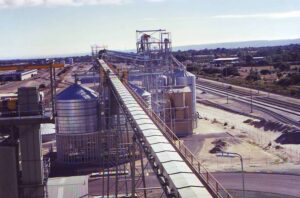
- Lower noise emissions due to lack of moving parts and fully covered design
- Fully covered design enhances product integrity and operator safety
- There are very few rollers and pulleys to monitor or grease
- A slight stream of air on the belt keeps the trough clean.